Illinois Hospitals Brace for Looming Resource Shortage During Pandemic

See Interactive Chart Here

By Juila Kindelin and Vanessa Corcoran

Gov. Pritkzer has predicted that Illinois’ peak for confirmed cases of COVID-19 will hit at least mid May, so the entire state must prepare for that peak.

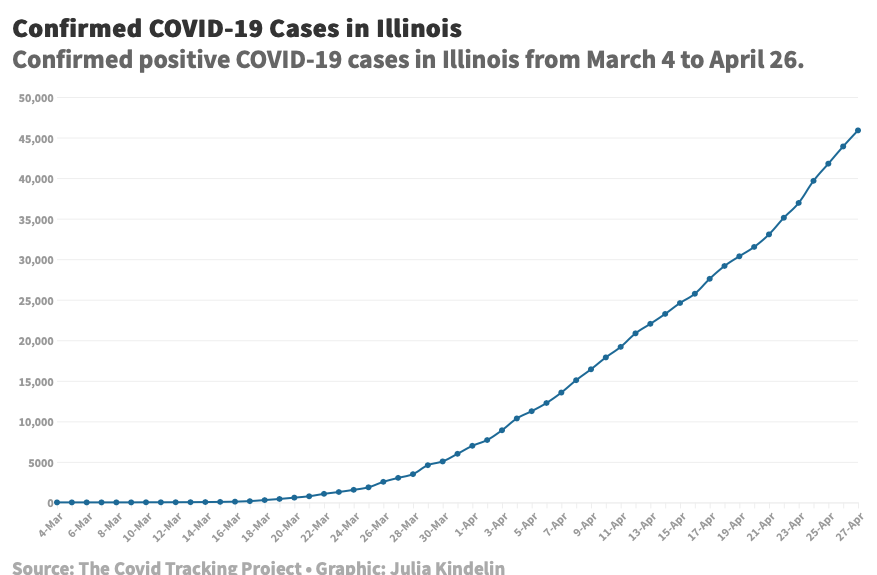
The Illinois Department of Public Health reports 242,189 people have been tested for COVID-19. 48,102 of those people have tested positive, and 2,125 have died. Since March 4, cases have steadily risen.

According to the CDC, coughing, shortness of breath, and high fever, are symptoms for COVID-19; if someone has been in close contact with a person known to have COVID-19, they must call before they go to a doctor’s office or emergency room. 

Caitlin Talaga, a registered nurse at Advent Health in Tampa, Florida, wants people to take the stay-at-home order seriously.

“As for my hospital, less patients have been coming in, people are actually complying to the stay in orders, and only coming in if necessary,” she said. “I personally think we are as serious as we can get as a nation. We shut it down completely other than grocery stores.” 

Healthcare workers are essential during the pandemic, and they continue to help, treat, and save thousands of lives.

Although there is no existing treatment to help those that test positive, a vaccine is underway to help fight against the pandemic. Dr. Paul Offiit, an American pediatrician specializing in vaccines told CNN that the process of acquiring a vaccine could take over 18 months. 

While experts say that the Illinois curve is beginning to flatten, scientists are still pushing the importance of testing. Currently, there are 46 testing locations across Illinois. Although testing sites are still growing, many have restrictions. Some are only testing medical workers, others require that patients exhibit flu like symptoms and have had known exposure to a COVID-19 positive individual.

Many have a pre-screening check prior to actual testing that helps determine which patients need the test most. Illinois is not yet at a point where widespread testing is available.

While The Institute for Health Metrics and Evaluation (IHME) shows that U.S. hospital resource use peaked on April 14, yet Pritzker said he doubts that Illinois has hit its peak. Projections indicate that the state will see its peak in mid-May. In hopes of reducing further spread, Pritzker announced that Illinois stay-at-home order will last through May and possibly into June.

This list only includes the locations managed by the Illinois Department of Public Health.

A registered nurse (who has chosen to remain anonymous) working at an Illinois hospital has been adapting to changes her hospital has made. 

“Our hospital built a tent in the parking lot that focuses on screening potential coronavirus patients,” she said. “Before entering the hospital, patients are met with a nurse who asks questions relating to viral symptoms and takes their temperature. The triage nurse can then decide if the patient should be seen in the emergency room or can be seen in the tent.

Measures such as these are key to avoiding unnecessary contamination and stressing the hospital system more than it already is.

As of April 28, 34% of the 3,645 staffed ICU beds statewide are being occupied by positive COVID-19 patients. Taking into account non COVID patients, Only 952 beds remain open across the state. 

Illinois has 3,602 staffed ventilators, 778 (22%) of which are being used on COVID patients. Subtracting non COVID patients, 2,453 ventilators remain. 

Despite Illinois’ good standing with the number of ICU beds and ventilators available, several regions have been hit harder. Hospitals in the City of Chicago region are nearing capacity. Only 14%, 162, of the region’s 1,124 beds remain available. The area still has 848 of their 1,405 ventilators available. 

See Interactive Chart Here

ICU beds and ventilators are used for the most sick patients, meaning the data available does not show the full extent of how hospitals have been impacted. 

In light of the looming ventilator shortage, new ventilators are being produced and existing ones have been transported to Hospitals in need.

Some Chicago Hospitals are doing whatever it takes to help each other. Lurie Children’s Hospital of Chicago shared in a Facebook post that they were sending multiple ventilators to Northwestern Memorial Hospital. 

Photo: Hospital staff at Ann & Robert H. Lurie Children’s Hospital of Chicago pose with ventilators ready to be shipped to aid adults at other hospitals. Photo by Ann & Robert H. via Facebook.

Other Illinois hospitals are benefitting from ventilators made by General Motors. After President Trump enacted the Stafford Disaster Relief and Protection Act on March 13, General Motors partnered with Ventec Life Systems to produce ventilators. 

So far, Franciscan Health Olympia Fields Hospital in Olympia Fields has received 10 ventilators. Another 10 will be shipped to Weiss Memorial Hospital in Chicago before the end of April. A third shipment containing 34 ventilators will be sent to the Federal Emergency Management Agency at the Gary/Chicago International Airport to be distributed to other locations. 

Deliveries of ventilators to hospitals in need are just one small way that Illinois is showing that there is hope.

In addition to preparing existing hospitals, The McCormick Place Convention Center has been transformed into a 3,000 bed medical facility. The first patients were admitted on April 17, and the unit is prepared to accept more COVID positive patients once hospitals are at capacity. The unit is designed to care for the non critically ill, but is fully equipped with emergency supplies.

Jacob Taylor, U.S Air Force Senior Airman, removes cots from an elderly wing at the McCormick Place Convention Center Alternate Care Facility. Photo by Master Sgt. Shelly A Stark, 183d Wing

An Illinois hospital nurse hopes that Illinois residents will cooperate with government implemented measures to reduce the spread of COVID-19 and prevent the hospital system from becoming overwhelmed. 

“I think that we all need to work together- the public and healthcare workers- to reduce the spread of the coronavirus.”

“Although we don’t have a vaccine or specific treatment interventions right now, we are able to practice social distancing and staying home to reduce the amount of exposure.”

Check out the Official Illinois Coronavirus website for up to date information.
Things you should know about the coronavirus

By Vanessa Maria Corcoran

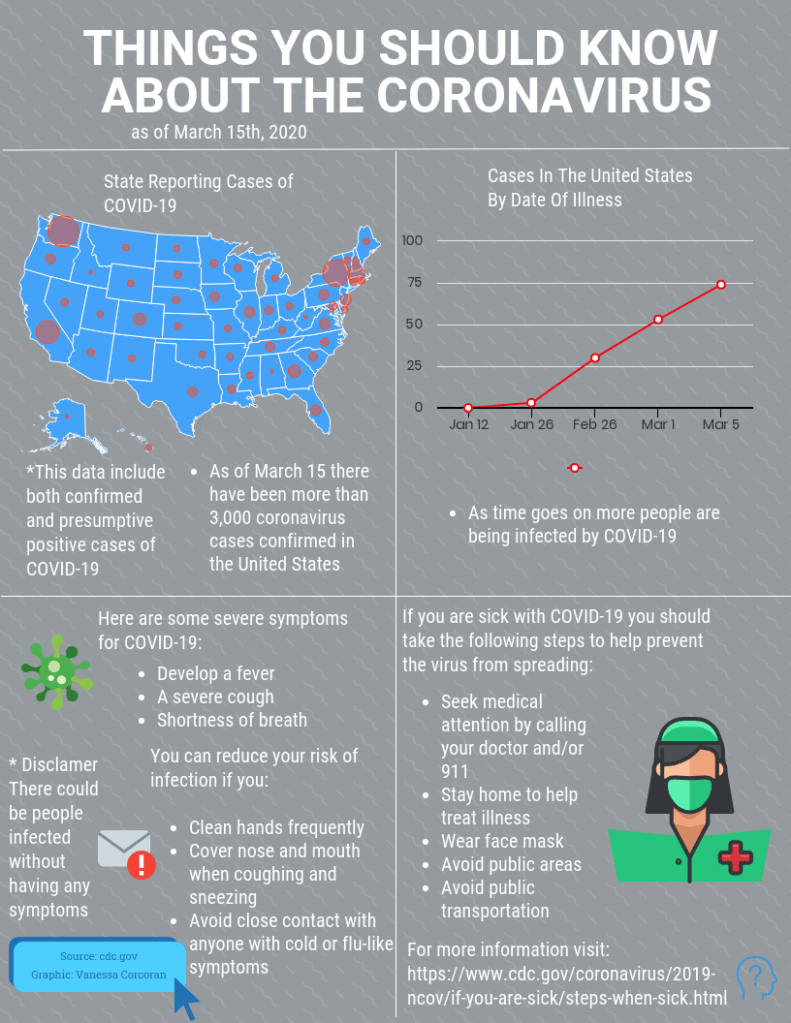
The coronavirus, also known as COVID-19, is quickly spreading across the globe. As of March 15th, 2020, there have been 6,471 deaths that have come from COVID-19. On the other hand, 76,856 people have recovered from the virus. According to the Coronavirus COVID-19 Global Cases map.

COVID-19 emerged in Wuhan, China in December 2019. The wet market in Wuhan is where the current outbreak may have started, and soon after COVID-19 spread among people and travel.

Where COVID-19 first started, shows that some people are at higher risk of getting very sick from this illness like older adults, people with heart disease, diabetes, and lung disease.

Some severe symptoms include high fever, intense cough, or shortness of breath. However, it appears that symptoms are showing up in people within 14 days of exposure to the virus.

There is no coronavirus vaccine yet, so to prevent COVID-19 involves frequent handwashing and staying at home as much as possible.

Source: CDC.GOV Graphic: Vanessa Corcoran

Chicago Red Light Cameras

By Vanessa Maria Corcoran

What are red light cameras and how do they work?

Red light cameras are digital cameras tied into the traffic signal system. The cameras record vehicles entering the intersection after the light turns red, while taking pictures of the rear of a vehicle with the license plate.

If you don’t stop properly at a red-light or run through a red-light, the images are then forwarded to the City’s Department of Revenue and tickets are sent to the registered owner of the vehicle shown in the pictures.  People who have received their $100 ticket in the mail can view the video of their violation on City of Chicago website.

Why does chicago have so many red light cameras?

The general arguement for the numerous amount of red light cameras are because they are suppose to increase the safety of Chicago while decreasing the number of crashes that happen. However, is actually all about the money?

According to the Illinois Policy Institute article, It found the red light cameras has taken $1.1 billion worth of tickets from 2008-2018. This means that someone is getting a $100 ticket every 33 seconds.

What happens next?

Many people want to ban the red light cameras entirely. Illinois Policy Institute mentions a bill to remove atleast 100 red light cameras in Illinois. If the bill passes, they would be required to remove all the cameras outside of Chicago by 2021.

Facebook vs. Instagram vs. Twitter

By Vanessa Maria Corcoran

What’s the most popular social networking service?

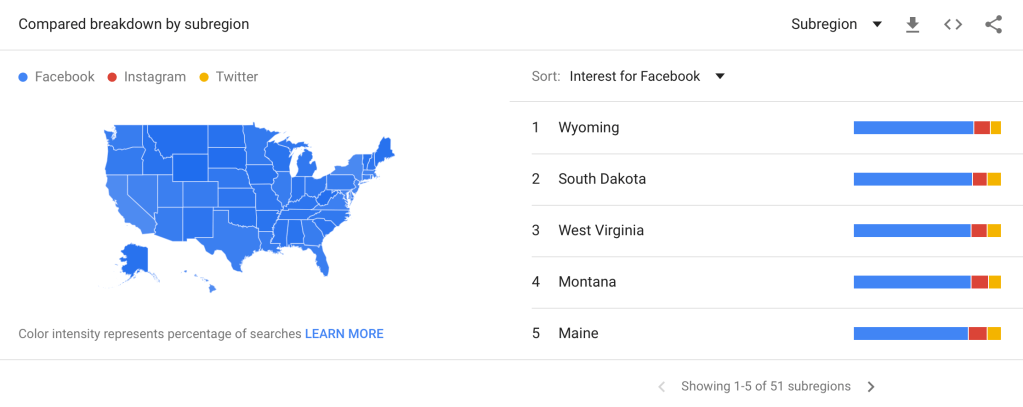
Facebook was created by Mark Zuckerberg in 2004. The social networking service makes it easy to communicate with family and friends online. By 2006, anyone with a valid email address could join Facebook. Today, Facebook is the world’s largest social network, with more than 1 billion users worldwide.

Another popular site, Instagram was created by Kevin Systrom and Mike Krieger and is a photo and video sharing social networking service owned by Facebook. Instagram has is very popular with a large social network of 700 million users.

Source: Google Trends

Lastly, Twitter was created by Jack Dorsey, Noah Glass, Evan Williams, and Biz Stone in 2006 and is an microblogging service in which users interact with messages known as “tweets”. Twitter continues to grow in popularity with about 330 million active users worldwide.

With all that in mind, Facebook is the most popular social networking site because it’s the only site that has 1 billion active users and Facebook in the last 12 monts has dominates the other social networking sites with the a high number of google searchers.

Source: Google Trends

Kim Kardashian vs. Kylie Jenner

Who is the most popular sister?

Kim Kardashian West is an American media personality, model, businesswoman, and actress. Kim Kardashian stars in “Keeping Up With the Kardashians” and continues to gain media attention since the reality show premiered in 2007.

Kylie Jenner is another American media personality who has also starred in Keeping Up with the Kardashians, and recently become the the founder and owner of her makeup company Kylie Cosmetics.

Source: Google Trends

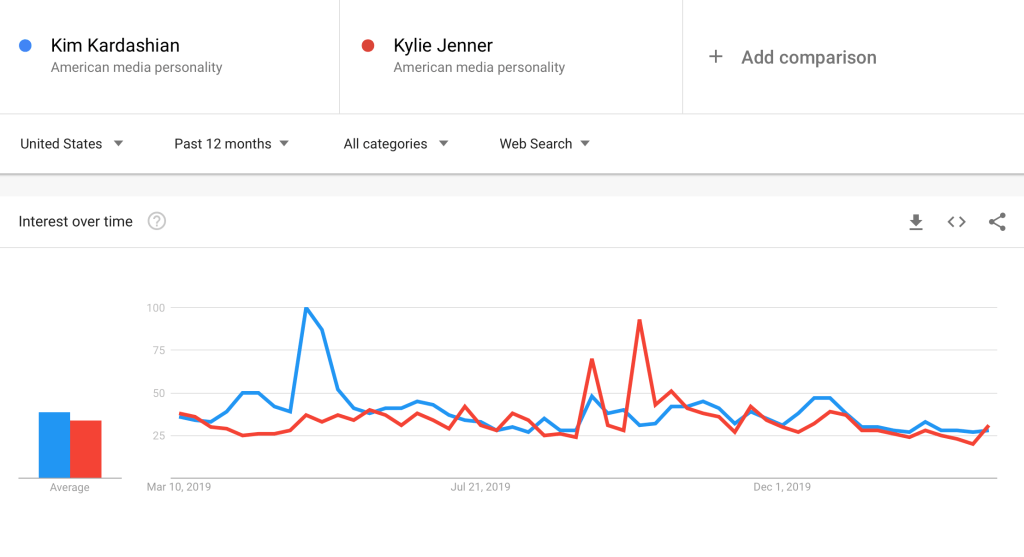
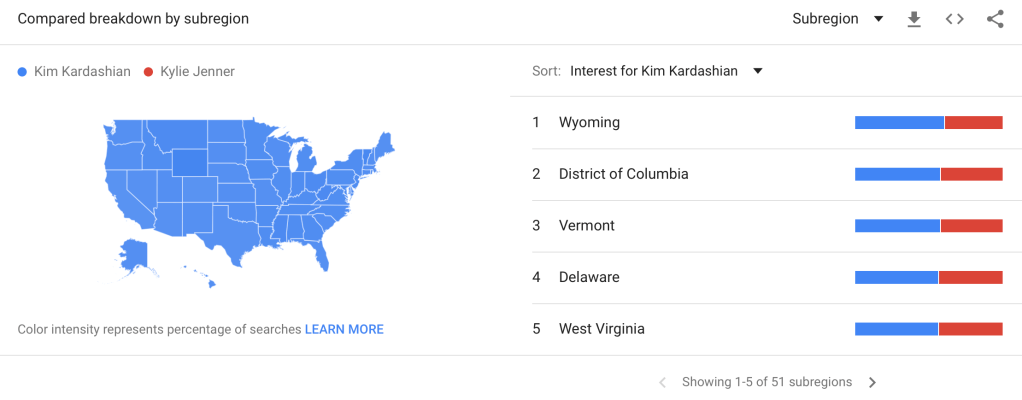
Kim Kardashian and Kylie Jenner have a similar amount of media attention, so it’s difficult to identify which sister the most popular, but Kim has been searched a little bit more than Kylie.

However, Kylie is the wealthiest member of the Kardashian-Jenner family, with a net worth of $1 billion. Forbes announced that Kylie Jenner took the title as the “Youngest Self-Made Billionaire” from Facebook founder Mark Zuckerberg.

Forbes estimates Kim Kardashian West is worth $370 million. In 2019, she was ranked number 26 on its list of “America’s Highest-Paid Celebrities“.

Source: Google Trends

CHICAGO WHITE SOX

By Vanessa Maria Corcoran

Chicago White Sox are an American professional baseball team based in Chicago, Illinois. The home ballpark for Chicago White Sox is Guaranteed Rate Field, and it’s located in the South Side of Chicago. The White Sox’s are also known as “South Siders,” as a reference to their location in Chicago. Moreover, the White Sox have won three World Series titles in 1906, 1917, and 2005.

The White Sox brought the first World Series championship to Chicago in the 21st century. Their former manger, Ozzie Guillén 2004-2011, helped the White Sox defeat the Houston Astros in the 2005 World Series.

Chicago swept the World Series with a 11-1 postseason record after a 99-win season in 2005. Many argue that 2005 will always be remembered as “The year of redemption in the Windy City.”

What have the White Sox done since winning the World Series in 2005?

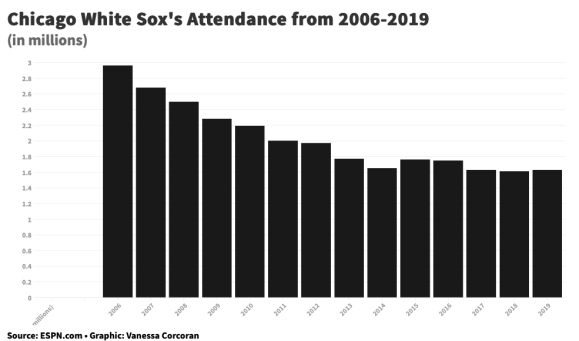
White Sox’s most recent AL Central Division titles were in 2000, 2005, and 2008. After 2008 the White Sox’s attendance goes down significantly reaching its lowest number of people in 2014.

Some possible reasons to why the White Sox attendance dropped is because Frank E. Thomas Jr. an American Hall of Famer, left the White Sox in 2005. Mark Burhrle who was not a Hall of Famer, but was still considered a great baseball player left the White Sox in 2o11.

In 2oo5 the White Sox had a win-lose ratio of 99-63, in 2011 it was 79-83, and in 2013 63-99.

See Interactive Chart Here

Chicago Pride Parade

By Vanessa Corcoran

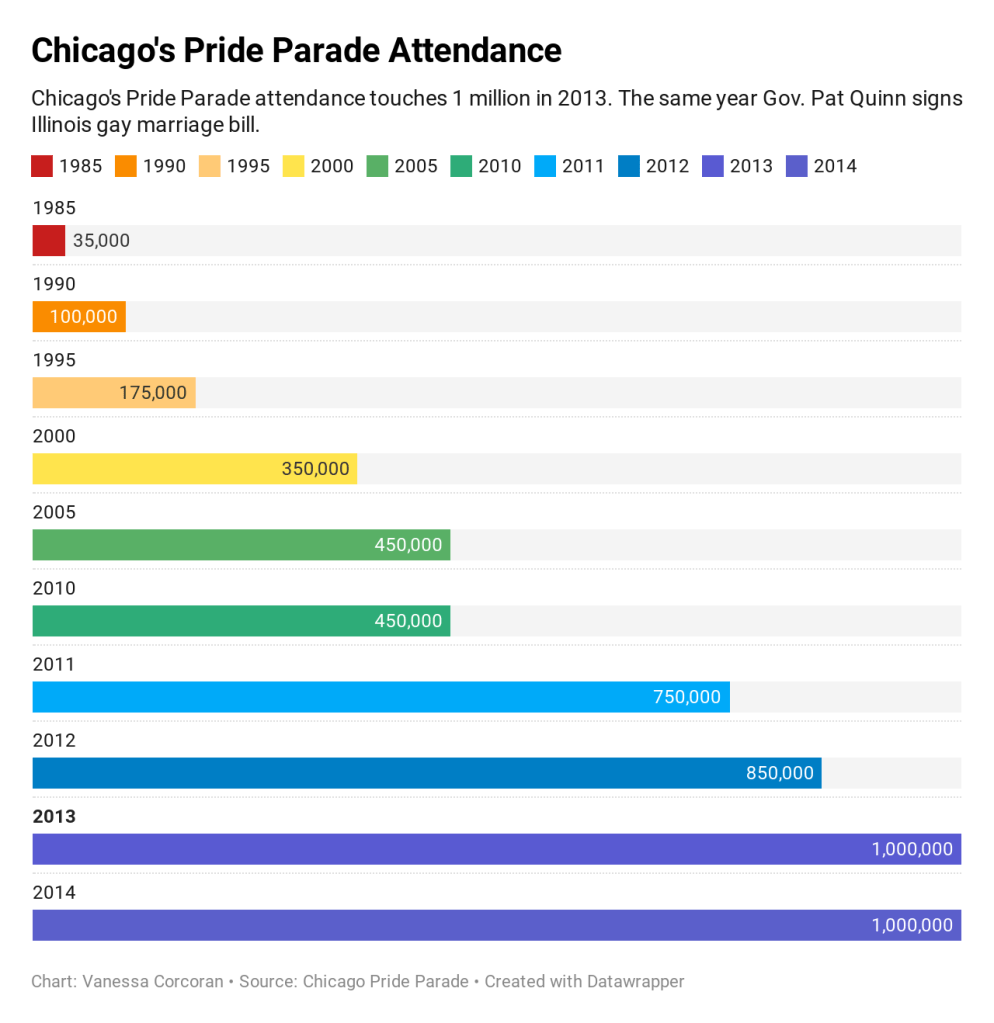
Chicago’s annual Pride Parade celebrates the lesbian, gay, bisexual, transgender, questioning, and queer community since June 27th, 1970.

Why are gay rights celebrated in June?

June is the LGBQT+ pride month because of the Stonewall riots in New York City’s Greenwich Village neighborhood. Members of the gay community came together against a police raid that began June 28, 1969. It’s a critical moment for the gay rights movement. 

Former president, Barack Obama, created the first national monument in order to tell the struggling story for LGBQT+ rights on June 24th, 2016. The Stonewall National Monument is anchored by Christopher Park, just across from the Stonewall Inn, where the uprising took place.

Illinois gay marriage bill

Former Gov. Pat Quinn signed Illinois gay marriage bill On November 20th, 2013. This historic moment made Illinois the 16th state to allow same-sex marriage in the United States.

On June 26, 2015 The U.S. Supreme Court made same-sex marriages legal in all 50 states in the Obergefell v. Hodges case.

Quinn Pensions Threatening MAP Grant Program

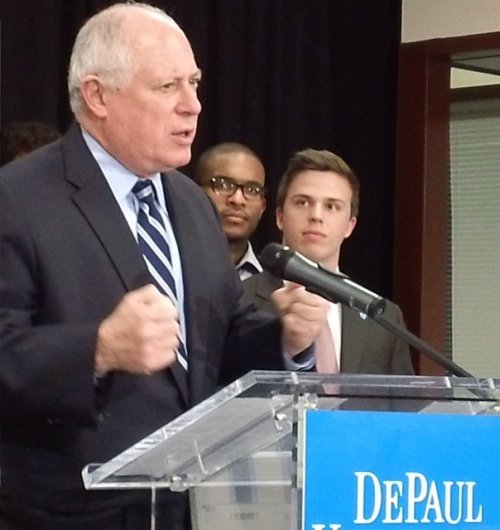
PHOTO CUTLINE GOES UNDERNEATH IT: Gov. Pat Quinn talks about MAP grants at DePaul University. (Photo/Bob Smith

Editor’s note: This story was originally posted on Dec. 12, 2012 and is housed at RedLineProject.org

By Bob Smith

Gov. Pat Quinn visited DePaul University’s Loop campus on Wednesday to discuss how pension reform is harming the Monetary Award Program (MAP) college scholarships and access to higher education in Illinois.

“This is so important to our state, not only in the past, but certainly now and in the future,” Quinn said.
“We want everyone to have the opportunity to go to college that has the ability to go to college.”

MAP grants are need-based college scholarships that allow merit students who are in need across the state and do not need to be repaid by the student. Quinn said that due to cutbacks and having to pay more money in the pension amount, almost 18,000 students lost their MAP grant scholarships this year.


“We do not want anyone denied that opportunity because of finances,” Quinn said. “We can’t afford to lose all the talent that exists, all the ability that exists for higher education to help our economy and to help all of us, because there are financial challenges that deny someone the opportunity to go to community college or a four-year university — public and private — in our state.”


“Every year over 5,000 DePaul students receive MAP grants, and just like the students who have already spoken here today, all of these DePaul students rely on this funding in order to continue their college careers,” Clemmons said.


“Because the number of Illinois students eligible to receive MAP is currently increasing, existing funding does not allow the state to assist all the eligible students. As a result, without action by the Illinois state leadership, more DePaul students than ever will see their MAP funding disappear this year and more

DePaul students than ever will be forced to give up their education due to finances.”

More than 150,000 students nationally receive MAP grants each year.

Clemmons told the audience that on Tuesday, DePaul’s SGA unanimously c


Ken Thomas, a University of Illinois Board of Trustees student member, MAP recipient and University of Illinois Chicago student, told how he wouldn’t be where he is today if it wasn’t for the MAP grant.


“My mom, when I was in high school, had to work two jobs just to keep food on the table,” Thomas said, “and if we didn’t have [the] MAP program like we do today, I know that I wouldn’t be where I am today; graduating with a degree, hoping to be a productive member of society.” 

Having a productive and functioning society and economy is what Quinn says it’s all


“Jobs follow brainpower,” he said. “We want to make sure we have smart people in Illinois. Well skilled, well-educated students coming out of college with graduate degrees and diplomas so they can create jobs, create new businesses,” he said. “Our goal in Illinois is to have at least 60 percent of the adults in our 

state with a college degree or college associate degree or career certificate by the year 2025. In order to achieve we have to make sure we have a good scholarship program.”


Clemmons said that in order for that to happen, state legislatures need to reflect upon the question, “What must be done?” and do what’s required. 

Design a site like this with WordPress.com
Get started